
Q. What is the best starting point – Land’s End ‘LE’ or John O’Groats ‘JOG’?
Each have their advantages and disadvantages as starting points:
- Land’s End ‘LE’ – easier to get to in general (unless you live in North Scotland) + you’ll be cycling with the prevailing wind BUT you’ll be locked into a timeframe as will have to book your return flight well in advance.
- John O’Groats ‘JOG’ – it’s psychologically easier to get more miles under your belt in Scotland to make the distances slightly easier for the last couple of days down in Devon/Cornwall + you have a lot more flexibility with the trains BUT you’ll be cycling against the wind most of the way.
Other useful points
- Ticket to Ride: an Inverness-based bike shop who arrange logistics for LEJOG – if you are cycling up to JOG, you can arrange to leave your bike at the Seaview Hotel and Ticket to Ride will courier it back to anywhere in mainland Britain for £75 (best check prices beforehand). Alternatively, if you are cycling from JOG, Ticket to Ride will (for a considerable fee!) pick you up from Inverness airport and drive you there – do try to share the ride with other people wherever possible!
- Bike boxes: if you are flying up to JOG, you’ll need a bike box….just ask your local bike shop to save you the cardboard box packaging from a new bike – you can then throw it away when you get to JOG [note – you’ll have to turn your pedals inside out, deflate your tyres, flip your handlebars sideways and lower your seat, so make sure you have the right tools when you get to the other end – alternatively, if you take a transfer from Inveness Airport with Ticket to Ride, they carry all the gear in their vans].
- Headstart: we flew to Inverness from Luton, landing around noon; factor in a 2.5-3.0 hour drive up to JOG and a good 45-60 mins unpacking/bike reassembly/photos/signing End to End forms…etc, so you should be on your way by 4pm. That meant we had a 2hour (50km) ‘shakedown’ to Lybster to sort out any niggles, and to take the edge off the next day. Plus, JOG isn’t exactly the sort of place where you want to spend all that much time!
- Train booking: yes, you can leave this until closer to the time, but prices do tend to rise quite a lot. The cheapest single from Penzance to Reading before we left was £33, but 4 days beforehand, it had gone up to £55. Oh, and don’t even think about booking online, as you have to reserve bike spaces on all trains from Penzance now (per the station sign, as of May-16) and of course you can’t do that online. That means then subsequently phoning up to find a train service with enough free bike spaces, and then cancelling your original train booking (£10 re-booking charge per ticket) before trying to rebook on the train you’ve now got your bikes on….because the guy on the phone can’t change the reservation for you – get my drift?!
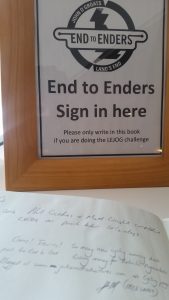
- End to End forms: pick these up from either the cafe at JOG or from the hotel reception at LE. You will have to have these ‘verified’ by places you stay at along the way (from memory, a minimum of 6 different ones). It costs £10 for your official certificate – you can either hand in the completed form at either of the end points (if they are open when you arrive), or post it off at a later date.
Q. How long should my LEJOG journey take?
First of all, have a rough idea of how much distance you are capable of comfortably covering in one day – 80, 90, 100 miles?
Then knock about 25% off this since you’ll be doing it:
- Day after day
- Fully laden
- Unsupported
It’s surprising how much time it can take to map read whilst on route, find cafes or accommodation at the end of the day, sort out mechanical issues, or cope with unfamiliar terrain.
We aimed to leave by 9:00am every morning, although inevitably we were almost always slightly behind our goal, 9:20-9:30am being a more realistic ‘on the road’ departure time. As a rule of thumb, allow at least 1 hour from the cooked breakfast being served (I am assuming you will be having the Full English most mornings!) to departure – at least, that was our yardstick.
Remember also, if you are in a bigger group, you will need to factor in ‘faff’ time for every departure, coffee stop, or just in general.
Taking all that into account, we averaged 19-24km/h per day which equated to a daily ‘Riding Time’ of roughly 6h45mins for 152km.
Since we rarely arrived anywhere before 6:30pm, that left around 2h 15mins for everything in between during the day – scheduled stops, map reading stops, call of nature stops…etc.
So figure a morning coffee stop of 35 mins, a lunch stop of 50 mins, an afternoon stop of 35 mins, and 15 mins general ‘faffing’ time, and you can see that’s your day.
Goes quite quickly, huh?!!!
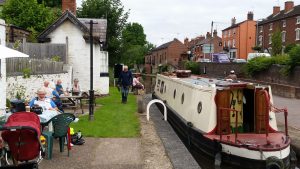
Personally, I don’t see any point in rushing through too much – you’re never going to beat the record, so you might as well enjoy it along the way, whether that means a wee whiskey tasting in Scotland or a leisurely lunch alongside a sunny canal in the Midlands. Take advantage of opportunities when they present themselves as there will still be times when you just have to grit your teeth and grind on regardless…..
Q. How should I get my bike ready?
A couple of fully-laden practice runs never go amiss!
Things I did to my bike which DID work:
- Fitted an Altura Dryliner bag to the front handlebars – great plastic map-reading folder on top, v.useful mesh pouch at the front, roomy inside, and clicked off at the touch of a button to enable to be carried with a shoulder strap
- Turned my handlebar stem upside down – most stems angle slightly in one direction, so if they are fitted in ‘racing mode’ they will be angled down. Simply flipping them over, means you handlebars will be set higher up – far more comfortable for long-distance cycling
- Fitted a super compact chainring – so nice to have about 3 reserve gears compared to my previous set-up, especially when it came to Devon/Cornwall during the last couple of days! It was only £120 online from Wiggle, which I thought was great value, especially when you consider that a spare left crank arm alone had previously cost me £80-£90.
- Fitted a new chain at the same time as my new cassette – granted this was about 9 months previously, but they were both in good nick…..unlike Phil’s which was deemed ‘slightly worn’ before we set off and snapped at the end of Day 1. Chains will ‘wear’ in a certain way – one mechanic en route in Golspie ‘refused’ to just fit a new chain as there was no guarantee it would fix Phil’s problem.
Things which I SHOULD have done (or SHOULDN’T have done) to my bike:
- Cable-tied a couple of spare spokes to the frame – I was going to take some spare Mavic spokes, but couldn’t fit them into my Alpkit rear carry bag…..so didn’t, and very nearly regretted it when I stretched a spoke late on in LEJOG, thereby developing a very severe rear wheel wobble. Luckily, Halfords in Tiverton were great and managed to reduce the problem, but without spare flat-blade Mavic spokes, they couldn’t fit a replacement.
- Been more careful when fitting over-sized tyres – I thought I was being clever by fitting 25 and 28mm tyres to my racing bike which was used to only 23mm tyres. Actually, I was being a bit economical, because I’d originally ordered 28mm Continental 4 season tyres by mistake, fitted them, wondered why they rubbed so much, and by then it was too late to change them. However, I liked the feeling of additional comfort, so ordered the 25mm version, which I fitted to the rear wheel, the front just about being able to take a 28mm version….although any dirt or grime and the wheels clogged up very quickly.
- Tried to remove my seat post before ordering various panniers – carbon seat posts evidently have a tendency to ‘seize’ in carbon frames, especially when grease is used. Something to do with a chemical reaction requiring a specialist bike company in Bristol and the risky application of a blow torch with no guarantee of success. Apparently.
Q. How do I plan a LEJOG route?
There are loads of websites, e-books, and links to help.
However, I’d note the following:
- Use common sense – ‘A’ roads tend to be less busy in Northern Scotland than Southern England, and dual carriageways should be avoided wherever possible (especially the A30 death trap in Cornwall). Having said that, sometimes the judicious use of an ‘A’ road can save you a lot of time meandering up and down back roads…..common sense should prevail.
- Cycle paths aren’t always cycle-able – ‘safe’ LEJOG routes will frequently take you down canal paths and the like, which aren’t really suited to road bikes, especially fully-laden ones (the canals south of Wolverhampton being a rather ‘muddy’ case in point).
- City centre canal paths usually are cycle-able’ – having said that, just about all of the paths through City Centres were tarmac and a great way to cut through the traffic above, whilst being a lot more scenic. Hence, used judiciously, canal paths do work…..just get off them as soon as they get gnarly!
- The ‘Safe’ route, isn’t going to be the quickest route – we soon learned to mix ‘n match, depending upon time of day, weather conditions, and distance to left to travel!

Q. How should I arrange accommodation?
We cycled in mid-June, booked most of our accommodation (B&B’s & cheap budget hotels) en route and didn’t have any problems, apart from a bit of messing about in Devon/Cornwall at the end.
Having said that:
- There were only 2 of us for most of LEJOG – when we were joined by a 3rd person on Day 7, it did make things more complicated.
- We pre-booked the first 4 nights in Scotland (Lybster, Inverness, Pitlochry, Carnwass) – it was a good job we booked ahead for Inverness (on the Friday night), as there was a Rod Stewart Concert on the Saturday, and the town appeared to be sold out. So it does pay to have a quick check beforehand!
- Be careful of weekends – especially in major tourist places over the Summer season.